The Quiet After the Storm
THE QUIET LIED. It looked like stillness. It felt like aftermath. Not the comforting kind of quiet. The other kind. The kind that settles like ash. That buzzes in your ears like something just ended, but no one told your body. Like a verdict, whispered. It was the start of April 2025. I woke up surrounded by beeping ghosts and the aftertaste of antifreeze. My apartment creaked with a kind of stillness that made me feel like a trespasser in my own life. My German Shepherd lay beside me, twitching in sleep. The fridge buzzed like it had been holding itself together too long—like me. The clock on the wall ticked with surgical precision, like it was counting down to something I hadn’t agreed to. And the wind wouldn’t stop pressing against the glass, like it knew I was cracked. I didn’t move. I didn’t cry. I just sat in the dark and listened to my chest and tried to decide if the weight in it meant I was alive or not. My phone buzzed once. I didn’t check it. The notification sat like a ghost on the screen. At the same time a year earlier, I was in a psych ward.
That place isn’t a sanctuary. It’s a waiting room for people the world has run out of answers for. You count ceiling tiles because they’re the only things that don’t change. You learn which nurses bark and which ones weaponize warmth. You memorize the schedule, because unpredictability feels like violence. You smile when they ask questions because the right smile gets you out faster. You learn to survive systems built to contain pain, not heal it. There was a kid across the hall who screamed in Morse code. Three short, three long, three short. I don’t know if he meant SOS, but I counted each sound like it was my own pulse. I never learned his name. Six months before that, I was married to someone who weaponized concern.
No yelling. Just precise cuts disguised as clarity. “You’re too much.” “You don’t know how to function.” “You should be grateful I put up with you.” She didn’t scream. She didn’t need to. Her voice got inside my wiring. I once told her I was proud of something I’d written. She said, “You should write that down before you fall apart again.” She said my autism made me unlovable. And I believed her. You don’t just walk away from that kind of damage. You carry it. You wear it. It becomes your inner narrator. The one that whispers at parties. The one that edits your texts. The one that makes you feel like every room you walk into was fine until you got there. But it didn’t start there.
In 1989, while living in Bolivia, I once stuck a key into a socket because someone changed the wallpaper pattern. I was four. I screamed when the electricity hit, but not from pain—from
chaos. From the disruption of ritual. They called it a tantrum. I called it terror. That was the first time silence felt like safety. But this wasn’t a story I ever intended to tell. Not like this. Not for you. Not for anyone. This was meant to stay buried. Left in the basement with the bottle I almost finished drinking. Filed away under “too messy to explain.” I didn’t want to write this. Because writing it meant remembering. And remembering meant reliving the slow unraveling— the way shame moved in and made a home behind my ribs. Shame that I’m autistic. That I have to rehearse what comes naturally to others. That I second-guess every interaction until it echoes.
Shame that I stayed in a marriage where silence was a weapon, and I let myself be erased, inch by inch, until I forgot what my voice sounded like uncorrected. That kind of abuse—the slow kind, the kind that recalibrates your worth—it doesn’t just break you. It rewrites you. I stopped trusting people. Stopped answering honestly. I started pretending I was okay because it felt safer than being real and abandoned for it. Eventually, I convinced myself this was how it would be. That nothing would ever feel whole again. That I’d walk through the rest of my life like a ghost in my own story. I’m not religious, but there’s that saying: When you plan, God laughs.
Then came Ava. You’ll meet her. Eventually. She didn’t knock. She just arrived—like breath after too long underwater. She looked straight at me, not through me. Not around me, but at me. And somehow, she didn’t flinch. But I did. Because part of me wanted to be loved. And the rest of me
only saw alarms. Red flags that weren’t hers but looked just close enough to feel dangerous. So I sabotaged. Quietly. Gently. The way trauma teaches you to. I kept her at arm’s length and then ached that she didn’t feel close. Then she got sick. Hospital. IVs. Monitors. Sterile quiet. The kind of quiet that buzzes, not so different from the one I’d crawled out of. And I thought, “She’s going to need something to hold on to.” So, I opened a document. And I wrote. Not for healing. Not for publication. For her. Something to read to her. Something that explained why I’d been clawing so hard to be loved by someone who already loved me. It was a confession. It was a breadcrumb trail back to the parts of me I’d abandoned. It was hers. She never got to hear her chapter. And that sentence has never stopped echoing. But something happened in the writing. Something sacred. I felt breath again. Like the tiniest opening. Like the air in the room had shifted. Not warmer, not lighter, just possible. And I wondered, maybe this isn’t just for her. Maybe it’s for someone else too. Someone like you. Someone who’s been bent under the weight of someone else’s version of love. Someone who’s memorized the silence between insults and still called it peace. Someone whose voice was turned against them so many times, they stopped using it altogether. So, I kept writing. For you. Not to offer answers, but to name the ache.
Not to heal you, but to let you know you’re not walking through this haunted house alone. That healing is not linear. It doesn’t ascend like a movie montage. It doubles back. It hides. It knocks the breath out of you, then disappears. So if this story feels disjointed at times, that’s because it is. So was I. It will loop. It will fracture. It will forget itself and return. But stay with it. Stay with me. Eventually, it clicks. Like breath. Like silence broken. Like love—when you finally believe you deserve it. This book isn’t about healing. Not the kind you hashtag. Not the kind you put under a sunrise caption. It’s about what comes before that. It’s about standing in a basement with a bottle of antifreeze and not knowing if you want to die, just knowing you don’t want to be anymore.
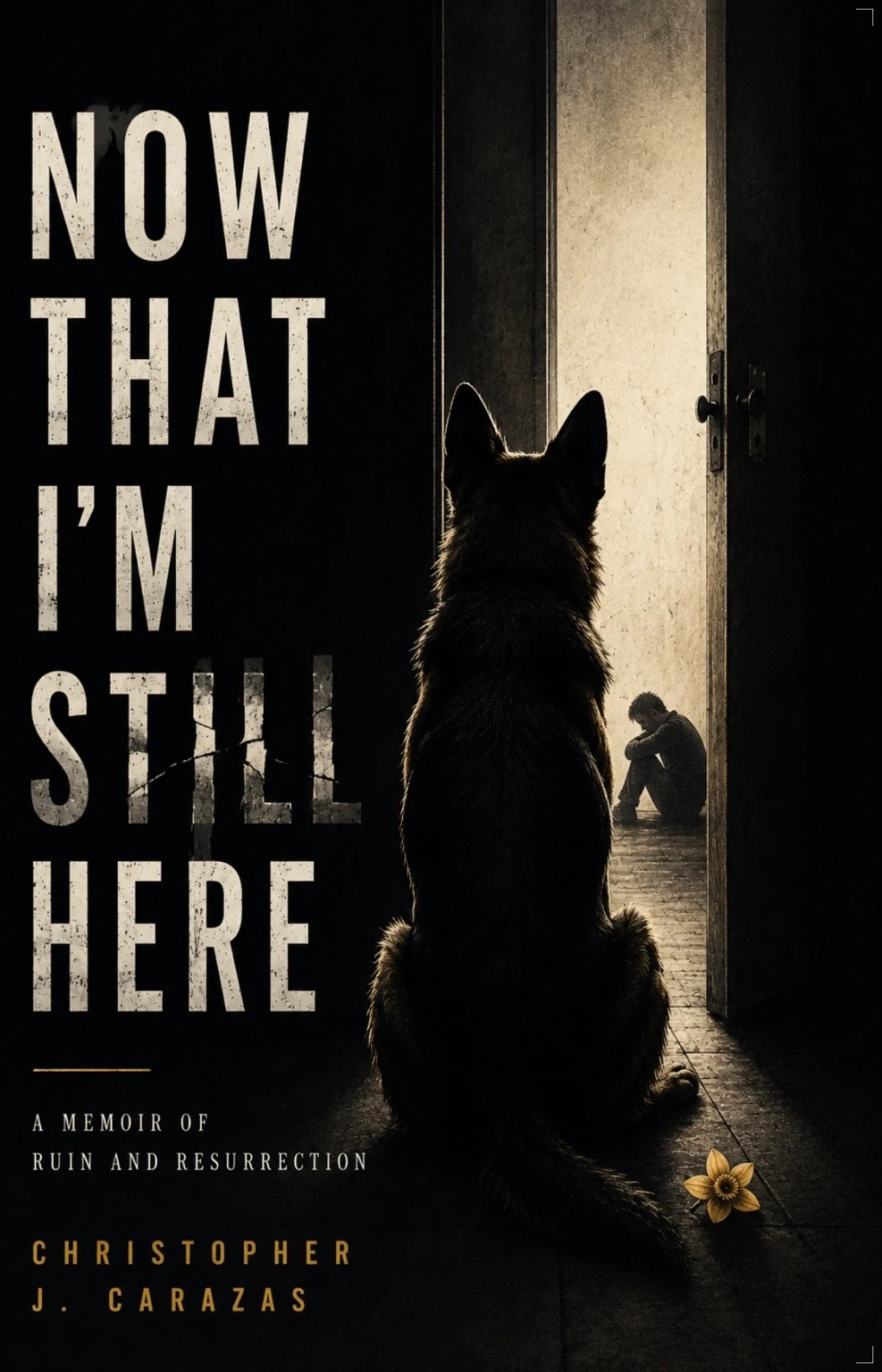
It’s about unscrewing the cap and wondering if this counts as suicide or just surrender. It’s about holding on because of a dog upstairs who still expects you to come back. Her name is Shadow. I got her in Madagascar. She has seen more than most people. She has curled beside me in every storm I couldn’t name. She waited outside every door I locked behind myself. When I wanted to die, she scratched at the frame like she knew. Like she refused to let go. Because of her, I walked. Because of her, I spoke. Because of her, I survived. This book is about the silence after the scream. When nothing moves. When the echo clears. And you realize you’re still breathing.
It’s about how, somehow, love showed up with Ava, four months after Marianne disappeared from my doorway. Only two months after I staggered out of the ward still shaking. Before I earned it. Before I was ready for anything.
Before I believed I could hold something tender without shattering it. And she didn’t flinch. Not once. Not even when I did. She sat next to me once and didn’t say a word. Just reached out, touched my hand, and didn’t pull back. I kept waiting for the judgment. For the shift in her eyes. It never came. She stayed. Like stillness. Like clarity. So no, this isn’t a hero story. It’s not a comeback arc. It’s a record of survival. Of slow, stubborn breathing. Of learning to exist again after your own voice was turned against you. If you’ve ever stood in the doorway of your own life and thought, they’d be better off without me. If your name feels too heavy in your mouth, if your skin feels more like a wall than a home. This book is for you. I didn’t die. I didn’t disappear. But more than that, I clawed my way back. Inch by inch. Breath by breath. Some days I still do. I showed up to the stillness. I stared down the silence. I stayed. And maybe that’s not a miracle. Maybe that’s not something that gets quoted under a sunset photo. But it’s mine. It’s survival. It’s breath I wasn’t supposed to take and I took it anyway. If you’re still breathing too—scarred, shaky, unsure—then maybe that counts for something. No. Not maybe. It counts for everything. Even if no one claps. Even if no one sees. Especially then.
The sample ends here. The reckoning continues in the book.